Dinosaurs at Your Bird Feeder?
And God made the beast of the earth after his kind, and cattle after their kind, and every thing that creepeth upon the earth after his kind: and God saw that it was good. (Genesis 1:25 KJV)
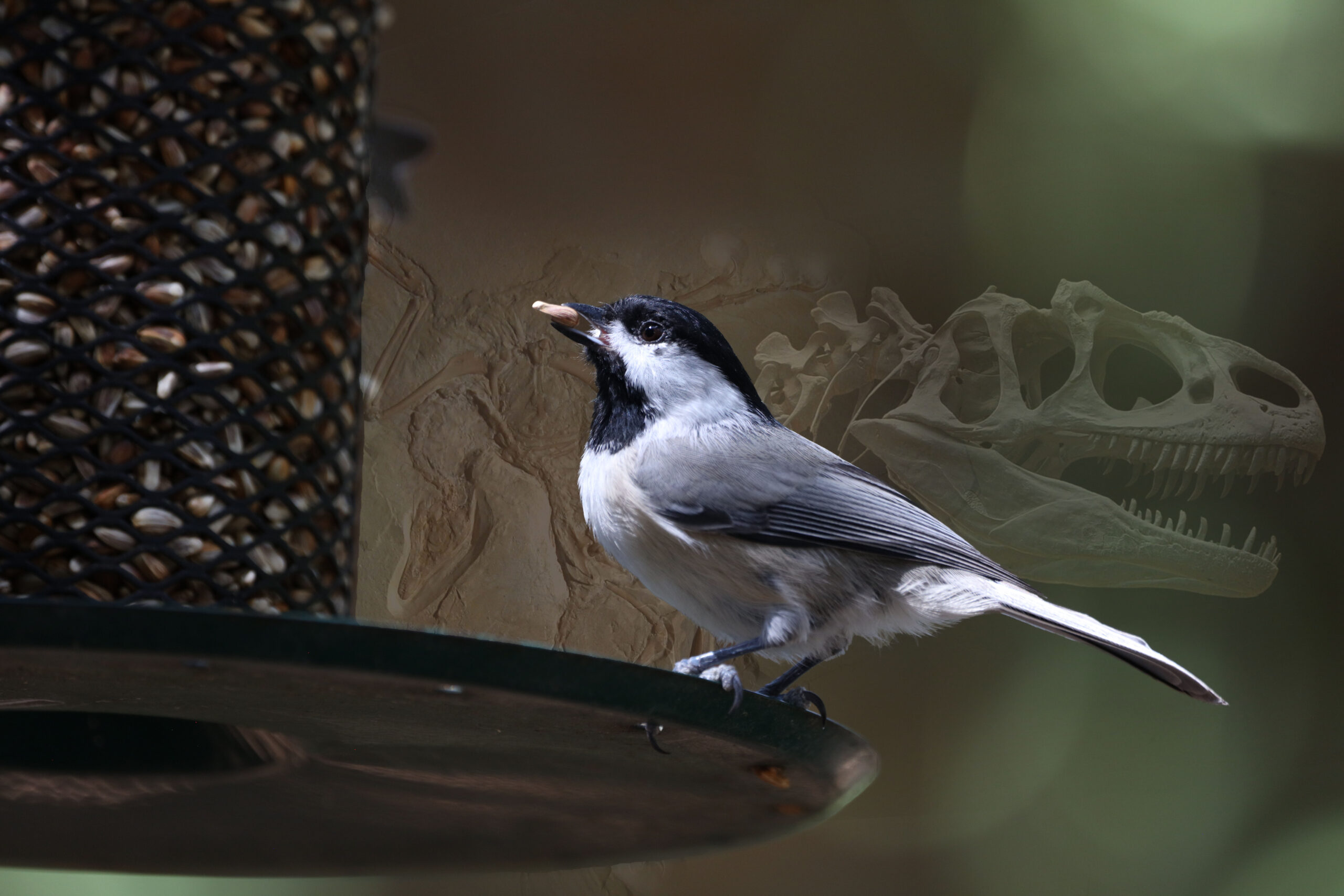
If you go to a natural history museum or read a book that addresses dinosaurs these days, you are very likely to see pictures of dinosaurs with feathers. But seeing the very name ‘dinosaur’ means ‘terrible lizard,’ why would they have feathers? One dinosaur researcher, Gregory Paul, put it this way: “Birds are literally flying dinosaurs.”(1) You see, among those with an evolutionary worldview, the belief that theropod dinosaurs evolved into birds has become very popular. This oft-repeated idea is obviously incompatible with the Bible’s account of creation, with flying creatures made on day five, and land creatures made on day six. So, are there dinosaurs at your bird feeder, and is this a problem for those who believe the Bible?
First, What Is a Theropod?
When talking about dinosaurs, the term theropod basically refers to those dinosaurs that walked on two legs and are thought to have been carnivorous (among other characteristics). This is the group of dinosaurs claimed as the birds’ ancestors. A couple examples of theropods are Tyrannosaurus rex and Allosaurus.
Are They Really That Different?
On a superficial level, theropod dinosaurs and birds do seem to have some similarities. They have the same body shape overall, but the similarities run out fast when you take a deeper look. Birds are amazingly designed for flight, and as we’ll see, dinosaurs were not. Let’s take a look at some of the changes that would have to have happened for a theropod dinosaur to evolve into a bird.
How Does One Make a Bird?
To evolve a bird from a dinosaur, here are just a sampling of the changes necessary. From the fossil evidence it seems dinosaurs primarily had scales, while birds have feathers. This in itself is an enormous difference, because feathers are highly complex structures that form out of a follicle and have a central vane, or rachis, supporting an amazing interlocking system of hooks and barbs. The follicle is connected to nerves and muscles, so that movement of individual feathers is possible. On the other hand, reptile scales are much simpler, being made of folds in the skin. The respiratory system of birds uses a highly efficient pass-through design that lacks a diaphragm muscle. This is far different from a reptilian dinosaur respiratory system, that was more similar to our lungs, and had a diaphragm.

The ability to fly is a major difference between dinosaurs and birds. Most of the theropod dinosaurs had large hind legs and small arms unsuitable as wings. Bird’s wings are well designed for flight, with their extra-large wing muscles anchored to an enlarged space on their sternum called a keel.
These are just a few differences, though we could also mention how birds have an oil gland for preening their feathers, or how birds and dinosaurs have a different point as their center of balance, among many others. Suffice it to say there are major hurdles to evolving a dinosaur into a bird.
But What About The Fossils?
While above it was mentioned that feathers are something unique to birds, there are claims of dinosaurs that have been found with feathers. Let’s look into some of them. (Prepare to encounter long scientific names!)
First, most of the claims of feathered dinosaurs fall under the category known as ‘dino-fuzz.’ These are fossils that have somewhat of a fuzzy outline that evolutionary scientists often interpret as something they call ‘protofeathers.’ Notice these are not full flight feathers like we would see on a bird, but what is hypothesized to be early precursors to feathers. A good example of a fossil that had this fuzzy outline is a dinosaur called Sinosauropteryx. There is disagreement over what this fuzz is, though, and there is a lot of evidence that it could be frayed collagen fibers from decaying skin,(2) not protofeathers. This seems particularly to be the case, since similar ‘fuzz’ has been found in a fossil Ichthyosaur(marine reptile), a shark, and various other animals that obviously didn’t have feathers.(3)
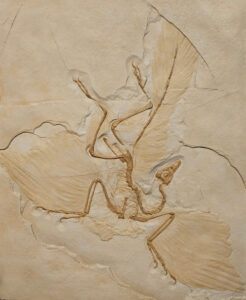
There are other fossils that don’t have dino-fuzz, however. These fossils have fully formed flight feathers. Some of these include Archaeopteryx, Caudipteryx, and Anchiornis. When we look at the skeletal anatomy of these fossils, though there are some unusual features, what we see is bird anatomy, and it seems the best identification for these fossils with fully formed feathers is that they were true birds. They are unusual birds, but often extinct members of a group seem unusual to us.
What The Bible Says About It
In the first chapter of the book of Genesis, the creation of flying creatures such as birds, and land creatures such as dinosaurs is described. Not only did God create the animals “according to their kind,” He even created birds and dinosaurs on separate days. The only reason to interpret the fossil evidence as showing an evolutionary transition is if we are already operating out of an evolutionary worldview. The fossil evidence itself is consistent with the Bible.
Science Is Not At Odds With The Bible
While this has been a very brief look at a topic about which whole books could be written, it seems there is no need to be intimidated by the dinosaur-bird evolution topic. There are enormous differences between dinosaurs and birds, and when we look at the fossil record, we see two separate kinds of animals, just as we would expect in light of the creation account. Once again, the Bible makes sense of the evidence around us.
A Different “Transitional Form”
While we don’t see evidence of clear evolutionary transitions in the fossil record, there is a transition the Bible talks about. 2 Corinthians 5:17 says, “Therefore if any man be in Christ, he is a new creature: old things are passed away; behold, all things are become new.”(KJV) More than a transition, this is a transformation! Jesus died to reconcile you to Himself. Have you experienced His transformation?
(Originally published in Reaching Out, Issue 124)